 Bnbscan
 contract verification matches published source code with a deployed contract
Bnbscan contract verification checks whether submitted source code compiles into the bytecode associated with a deployed BNB Smart Chain contract. A successful match gives readers inspectable code tied to that address. Exact Match includes deployment constructor arguments, while Similar Match does not establish those inputs.
Publishing readable code lets someone examine contract functions before considering a transaction or token approval. An exact-match submission needs sources and settings that reproduce the deployed build; recover any missing inputs before submitting. Proxy deployments also require attention to the implementation supplying their logic.
Bottom line: Source publication generally cannot be undone, so preserve the original build and review every submitted file before making it public.
A bytecode match makes the published logic inspectable
Matching a rebuilt contract against its deployment connects readable functions to the program at a specific address on BNB Smart Chain. Without that connection, a source listing might describe code different from the deployed program. Once verification succeeds, the explorer makes the matched source available through the contract record. Readers can examine function bodies, access restrictions, and dependencies directly. This supports meaningful review before interaction, especially when a contract exposes functions whose names reveal little about their behavior. The match applies to the selected deployment; sharing a contract name does not establish the same relationship.
Source code, deployment bytecode, and the ABI have different jobs
Source code expresses a program in a language such as Solidity. The compiler produces creation bytecode for deployment and runtime bytecode for the code the contract executes afterward. Those outputs differ, so comparing an entire creation payload directly with runtime code answers the wrong question.
The Application Binary Interface, or ABI, describes callable functions, their parameters, return values, and events. Software uses it to encode calls and interpret responses. An ABI alone does not reveal the implementation. Different contracts can expose matching function signatures while executing different logic.
The explorer uses the ABI for its Read Contract and Write Contract views. The source explains the behavior behind those visible controls.
The original compiler configuration governs a reproducible match
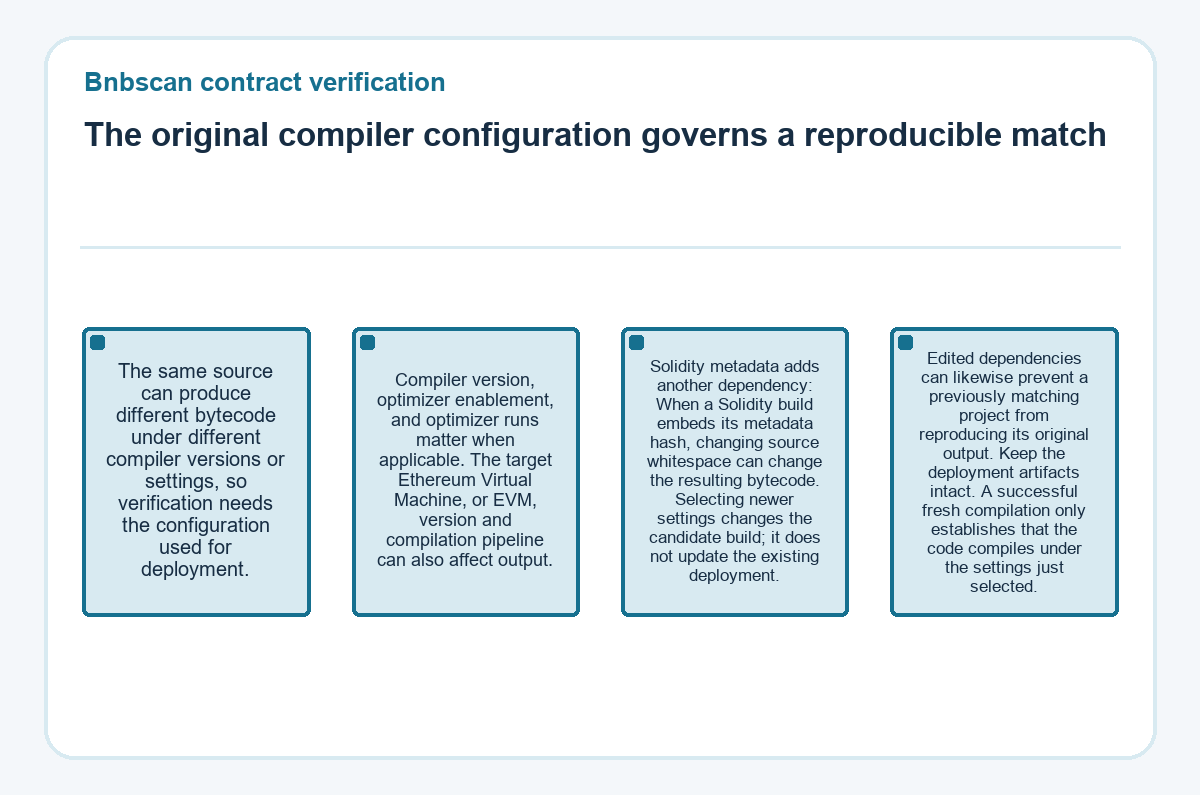
The same source can produce different bytecode under different compiler versions or settings, so verification needs the configuration used for deployment. Compiler version, optimizer enablement, and optimizer runs matter when applicable. The target Ethereum Virtual Machine, or EVM, version and compilation pipeline can also affect output. Solidity metadata adds another dependency: When a Solidity build embeds its metadata hash, changing source whitespace can change the resulting bytecode. Selecting newer settings changes the candidate build; it does not update the existing deployment. Edited dependencies can likewise prevent a previously matching project from reproducing its original output.
Keep the deployment artifacts intact. A successful fresh compilation only establishes that the code compiles under the settings just selected.
Single-file input and Standard JSON preserve different build details
A single-file submission supplies one complete source listing, while Standard JSON can preserve multiple source files and explicit compiler settings. Flattening must resolve imports; references to unavailable files prevent the verifier from compiling the submitted material. Standard JSON matters when the original build used advanced options such as
viaIR
or a nondefault
bytecodeHash
setting. The verification method must carry those settings rather than silently substituting compiler defaults. Browser forms and automated submissions both serve the same matching task. Automation reduces manual copying; a successful match still requires the correct sources and deployment configuration.
Constructor arguments and library addresses specify the deployed instance
A verification form requesting constructor arguments expects the original deployment values in ABI-encoded hexadecimal form. The constructor’s parameter types and order determine that encoding. Current storage values cannot substitute for deployment arguments because later transactions may have changed them. For contracts without constructor parameters, there are no constructor argument values to supply. The relevant comparison uses the deployment data for that contract, not settings borrowed from another address with similar code.
Externally linked libraries introduce their own deployment inputs. The verifier needs the library names and addresses used by the original build when those links exist. An imported library does not always create an external link; the compiler can incorporate internal library code directly. The build’s actual link requirements determine which addresses matter. Replacing a library address changes the candidate deployment even when its source files remain identical.
Exact Match and Similar Match establish different deployment scope
Exact Match covers the verified contract code together with its deployment constructor arguments. That scope gives readers more information about the particular instance than a match inherited from another verified address.
Similar Match associates an address with already verified source through matching contract bytecode. Similar Match verification does not check the deployment’s constructor arguments. The associated source can still help explain the contract’s logic, while its initial settings need separate attention.
An Unverified label means the explorer has not published matched source for that address. It does not establish whether the program behaves correctly.
Keep inspection separate from irreversible publication
If the original compiler settings for an unverified contract are missing, pause before attempting source publication. Inspecting the existing contract record leaves the source unpublished; completing verification generally makes the submitted source public without an ordinary undo option.
- If the address or network differs from the deployment record, resolve that mismatch before submitting code.
- If source files or build settings are missing, resolve those gaps before treating a candidate build as the deployed version.
- If the build reproduces the contract, review the intended submission for sensitive comments, credentials, or unrelated files.
- If public disclosure is acceptable, choose Verify and Publish in the Contract tab and submit the matching source with required deployment inputs.
- Stop when the explorer confirms verification for that address and displays the expected source; a receipt alone does not confirm a match.
Sensitive content is a reason to stop publication. Silently editing source files can change the build and leave the original deployment unmatched.
Compilation errors and bytecode mismatches need different corrections
Compilation errors mean the verifier could not build the submitted material. Unresolved imports, unavailable identifiers, or incompatible compiler syntax require correcting the compilation input. A bytecode mismatch concerns candidate code differing from the target deployment. A missing-code error instead concerns the selected address, network, or deployment recognition. Repeatedly sending unchanged input does not resolve a reproducibility problem, and rewriting a function for a different compiler changes what the submission tries to prove.
Automated verification can return a submission identifier before processing finishes. That receipt supports tracking, not a successful match. The final verification status and published Contract tab establish whether verification completed. A submission identifier supplies no completion deadline. An already-verified response also calls for reading the existing record before attempting another submission.
Proxy source and implementation source explain different code
Proxy source describes forwarding code, while implementation source describes delegated logic at a separate contract address. Verifying only the proxy leaves the implementation’s behavior unexplained.
The explorer’s proxy tools associate a proxy address with an implementation and use the implementation’s ABI for Read as Proxy and Write as Proxy controls. That association relies on detection heuristics, which can misidentify contracts or miss custom arrangements. A displayed implementation therefore does not establish that every call reaches the code shown. The forwarding rules and the implementation both matter when interpreting the contract.
An upgradeable proxy may change its implementation while retaining its own address. Verification of an earlier implementation does not cover every replacement. Source review must concern the implementation applicable to the interaction being assessed, rather than an older implementation sharing the same proxy history.
Does verified source code mean a contract is safe?
A verified contract can still contain dangerous permissions or exploitable logic because code matching does not test whether its behavior is safe. The published source makes that behavior available for examination. A security review considers the functions’ actual effects, access controls, and dependencies. Formal verification addresses correctness against specified properties, which differs from reproducing bytecode. Current contract state also matters wherever the code permits configuration changes. Read-only inspection and authorization to change contract state remain separate actions. A source verification label alone gives no reason to sign an approval or execute a write function.
Common questions about Bnbscan contract verification
Do I need BNB to submit contract source code?
Submitting source code for explorer verification does not itself consume BNB gas because it does not execute an onchain transaction. Deployment and later state-changing contract calls are separate operations with network fees. A combined deployment-and-verification tool can perform both tasks, so its deployment gas must not be attributed to source publication.
Which contract name belongs in a project containing several Solidity contracts?
Use the name of the contract deployed at the target address, rather than one of its dependencies. For Standard JSON API submissions, the contract identifier includes its source-file path and contract name. A matching file bundle can still fail verification when the submission selects the wrong compilation target.
Can I verify Vyper source as a Solidity contract?
Vyper source requires the Vyper verification method and the compiler version used for deployment. The API accepts Vyper source in its own JSON format. Selecting Solidity settings cannot reproduce a Vyper build, even when the contracts expose similar functions. Supported compiler versions also constrain which original builds the verification service can process.
Does source verification also prove ownership of the contract address?
Source verification establishes a code match, while contract-address ownership verification connects the deploying address with an explorer account. Those are separate checks with different purposes. Publishing matched source does not grant control over the contract or establish that the submitter controls its deployment address.
Will testnet verification carry over to a mainnet deployment?
A testnet verification does not by itself establish verification of a mainnet deployment. Each result concerns a contract address on a particular network. Even when source files or address strings coincide, the mainnet contract has its own deployment context. Shared API credentials do not merge those records into one verification result.
Is a verification badge enough to establish BEP-20 compliance?
A verification badge establishes a source-code match rather than conformance with every BEP-20 requirement. The published implementation still needs assessment against the token standard, including its behavior as well as its function signatures. A recognizable token name or matching interface does not settle whether the implementation follows the standard.
When can verified token code support a token information update?
Verified token source is a prerequisite for submitting token information changes, and verification does not automatically publish new token details. The owner can submit a token information update after verifying contract-address ownership and linking that address to an explorer account. Each request requires review and approval before publication. A code verification badge therefore does not establish that the explorer has accepted a requested name, logo, or description.
· last updated